


Prognostics & Health Data
Prognostics and Health Management (PHM) programs use data collected across missions and operating hours to understand how engines, structures, avionics, and other critical subsystems are changing over time. That can include vibration, temperatures, loads, fault codes, operating cycles, bus traffic, and subsystem diagnostics.
Unlike a single test event, the value of PHM data builds as the platform operates. A complete, accurately timed record gives engineers the history they need to identify degradation trends, investigate developing faults, and make maintenance decisions based on actual platform condition.
Built for the PHM Data Environment
PHM brings together data from systems that were not necessarily designed to tell one story. Engine parameters, structural measurements, avionics buses, diagnostics, and fault messages may all arrive at different rates and from different sources. The challenge is keeping that information complete, correlated, and usable across the life of the platform.

Continuous Data Collection
Health trends develop over time. Missing missions or incomplete recording periods can create blind spots in degradation and remaining-life analysis.

Accurate Time Correlation
Engine, structural, avionics, and subsystem data may come from different sources. Timing errors can make it difficult to determine which events happened together.

Multi-Source Data Capture
PHM programs may combine bus traffic, analog measurements, subsystem diagnostics, fault messages, vibration, temperatures, and other platform-health data in one record.

Long-Term Onboard Operation
Recording hardware may remain installed through normal platform operations, where vibration, shock, temperature, power, and duty-cycle requirements are part of everyday use.

Secure, Accessible Records
Platform-health data has to remain protected onboard while still being practical to retrieve, transfer, and use in maintenance and engineering environments.

Evolving Monitoring Requirements
New sensors, monitored subsystems, interfaces, and analytics can be added throughout a platform’s lifecycle. The recording architecture has to evolve with them.
From Platform Health Data to Maintenance-Ready Evidence
Capturing health data is only the first step. After the mission, recorded information has to remain synchronized, indexed, accessible, and trustworthy enough to support fault investigation, trend analysis, prognostic models, and condition-based maintenance decisions.
Ampex recording architectures preserve that record from onboard collection through offload and analysis. Every Ampex recorder includes ACCE, providing a common software environment for data acquisition, timestamping, indexing, management, and control so recorded health data remains organized and ready for downstream use. Ampex confirms ACCE ships pre-installed across its recorder family and provides a unified software-defined environment for capture, indexing, and data management.

Recording Built Around Your PHM Architecture
No two health-monitoring programs collect exactly the same data. Ampex recorder platforms can be configured around the required interfaces, throughput, storage, timing, security, and SWaP-C rather than forcing the program into a fixed architecture.
MAX High-performance recording and edge compute up to 5 GB/sec sustained and 300 TB of storage.
PLUS Expanded performance and I/O at 750 MB/sec–1.5 GB/sec with 8–80 TB+ of storage.
BASE Compact onboard recording at 200–250 MB/sec with 2–20 TB of storage.
FLIGHT TEST Purpose-built acquisition and synchronization up to 1,000 Mb/sec with 4 TB removable storage.
RACK MOUNT Ground-side recording and processing up to 100 Gb/sec with 187 TB+ of storage.
Why Ampex for Prognostics & Health Data
PHM programs need more than a recorder. They need reliable, precisely timed data that stays usable across years of operation, changing platform requirements, and evolving maintenance workflows.
Ampex brings rugged recording, flexible integration, secure data handling, and long-term program support together in one architecture built for the life of the platform.

A Recorder Family That Scales
Five recorder levels let programs match storage, throughput, processing, connectivity, and SWaP-C to the actual health-data requirement instead of overbuilding the platform.
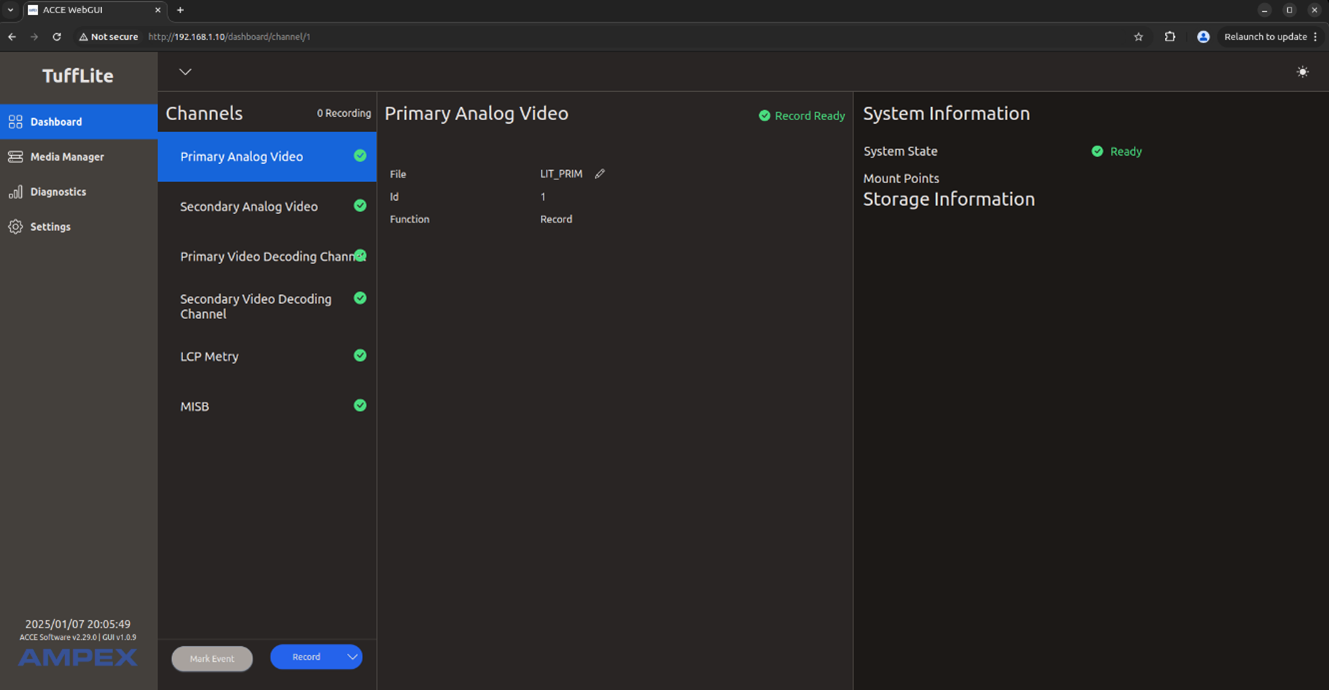
ACCE Across the Recorder Family
A common software-defined environment provides consistent acquisition, indexing, control, and data management as PHM requirements or recorder configurations change.

Timing You Can Trust
Support for established timing sources keeps engine, structural, avionics, and subsystem data correlated across missions and operating hours.

Built to Stay on the Platform
Rugged, SWaP-C-conscious architectures support equipment intended to operate alongside the platform through demanding environments and long service lives.

Interfaces That Can Evolve
Flexible I/O and open architectures give programs room to add monitored systems, interfaces, and analytics as the PHM program matures.

Secure From Collection to Offload
Encryption, removable-media options, and secure data-handling workflows help protect sensitive platform-health records from onboard capture through maintenance and analysis.
Let Ampex Help Configure the Right Recorder
A PHM recorder should fit the platform, the data sources, and the maintenance workflow, not the other way around.
Whether the requirement is continuous engine monitoring, structural-health data, subsystem diagnostics, or a broader platform-health record, Ampex can help configure a recording architecture around the required interfaces, timing, storage, security, and SWaP-C.