


Ampex Common Compute Environment (ACCE)


Ampex Common Compute Environment (ACCE) is a flexible, software-defined suite designed to simplify mission-critical data acquisition, storage, and device management. As defense operations become increasingly reliant on effectively managing vast and diverse streams of information from a multitude of sources, ACCE provides a unified interface for capturing, indexing, and securing mission data across rugged platforms operating at the tactical edge. This approach is crucial as these edge devices provide real-time information essential for immediate decision-making.
READ MORE
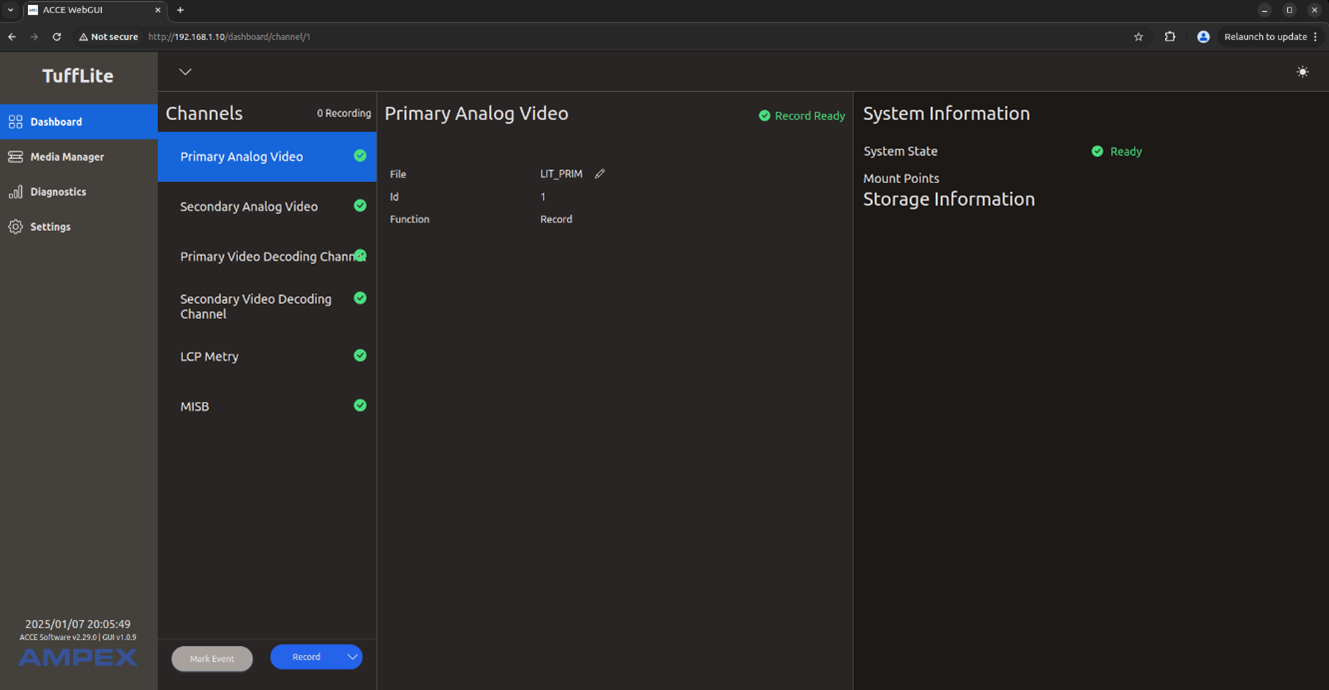
Every Ampex data recorder ships with the Ampex Common Compute Environment (ACCE) pre-installed, providing a unified, mission-ready interface for data acquisition, management, and control right out of the box. The beauty of this software-defined approach lies in its shift from traditional, often rigid, hardware-defined paradigms to a more adaptable, software-centric model.
Powered by Red Hat Enterprise Linux (RHEL), ACCE supports open architecture, advanced encryption, and third-party software integration—helping defense and aerospace customers stay ahead of evolving cybersecurity requirements without locking into proprietary systems. This software-centric design allows for quicker responses to newly identified threats or vulnerabilities and can seamlessly integrate with existing cybersecurity frameworks.
From real-time recording to rapid file indexing, ACCE gives operators full control over data in contested and remote environments. This is because software-defined systems offer the agility to rapidly adapt to changing mission requirements or surges in data volume by reconfiguring system parameters as needed. Whether supporting AI/ML at the edge or enabling CSfC-compliant encryption, ACCE is built to evolve with your mission.
Key Features
- Unified GUI for managing recording, decoding, and diagnostics.
- Supports multiple video, telemetry, and metadata channels, addressing the need to handle diverse data types efficiently, from simple textual logs to complex sensor information or high-resolution images.
- Accurate timestamping via IRIG and GPS sources.
- File indexing for rapid data access and retrieval.
- Seamless integration of third-party AI/ML and analytics software, facilitated by decoupling recording functions from hardware.
- Runs on RHEL with flexible hardware compatibility, optimizing data management within the capabilities of the underlying hardware.
Typical Applications
- Airborne and ground vehicle data management, such as for unmanned ground vehicles requiring flexible data systems for varied mission profiles.
- Mission-critical ISR data routing and storage.
- Flight test instrumentation systems.
- Zero Trust and CSfC-compliant platforms.
- Secure video and telemetry processing at the edge.
- Maritime Systems, enhancing data management for platforms like Autonomous Underwater Vehicles.
- Aerospace and Space Systems, like UAVs and satellites, managing diverse data types and offering scalability for increasing data rates.